Understanding the Empirical CDF (Cumulative Distribution Function)

Empirical CDF

Understanding the Empirical CDF (Cumulative Distribution Function) In statistical analysis, visualizing and understanding data distributions is essential for drawing meaningful conclusions. The empirical CDF, or empirical cumulative distribution function, is a powerful tool that represents the cumulative proportion of data points at or below a given value in a dataset. Unlike theoretical CDFs, which assume

Understanding the MSE Formula

MSE Formula Important

Understanding the MSE Formula In statistical modeling, particularly regression analysis, evaluating model performance is critical for ensuring accurate predictions. The MSE formula, or Mean Squared Error formula, is a widely used metric to assess the accuracy of a regression model by quantifying the average squared difference between predicted and actual values. MSE provides researchers with

Understanding Contingency Tables

Why Use Contingency Tables

Understanding Contingency Tables: A Guide for Researchers In statistical analysis, a contingency table is a powerful tool for examining the relationship between two or more categorical variables. Also known as a cross-tabulation or crosstab, it organizes data into a matrix format, displaying the frequency distribution of variables to reveal potential associations. Contingency tables are widely

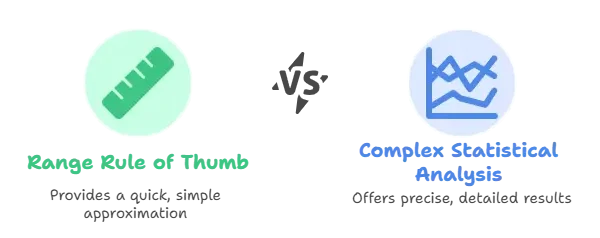
Understanding the Range Rule of Thumb

Understanding the Range Rule of Thumb: A Guide for Researchers In statistical analysis, understanding data variability is crucial for interpreting research findings. The range rule of thumb is a simple, practical method for estimating the standard deviation of a dataset using its range—the difference between the maximum and minimum values. This quick approximation is particularly

Random vs Systematic Error: Understanding Their Impact on Research

Differences Between Random and Systematic Errors

Random vs Systematic Error: Understanding Their Impact on Research In research, the accuracy and reliability of data are critical for drawing valid conclusions. Two types of measurement errors—random vs systematic error—can affect the quality of research outcomes. Random errors introduce unpredictable variability into measurements, while systematic errors cause consistent biases that skew results in a

What Is a Dependability Plan in a Dissertation Proposal?

What Is a Dependability Plan in a Dissertation Proposal? A Comprehensive Guide In qualitative research, ensuring the trustworthiness of findings is paramount, particularly in a dissertation where rigor is scrutinized. What is a dependability plan in a dissertation proposal? It is a structured strategy outlined in the proposal to demonstrate that the research process is

Understanding Statistics Reliability: A Comprehensive Guide for Researchers

Understanding Statistics Reliability: A Comprehensive Guide for Researchers

Understanding Statistics Reliability: A Comprehensive Guide for Researchers In any scientific research, whether in psychology, education, medicine, or social sciences, the accuracy and consistency of data measurement play a pivotal role. One of the core principles that determine the trustworthiness of research results is statistics reliability. If your instruments or tests do not consistently measure what

Cronbach’s Alpha in SPSS

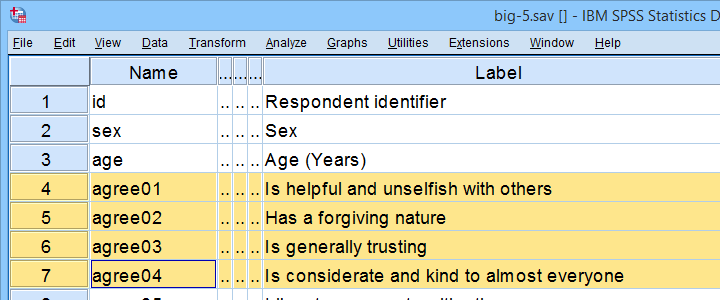
Cronbach’s Alpha in SPSS By Ruben Geert van den Berg under Factor Analysis Contents Cronbach’s Alpha – Quick Definition SPSS Cronbach’s Alpha Output Increase Cronbach’s Alpha by Removing Items Cronbach’s Alpha is Negative There are too Few Cases (N = 0) for the Analysis APA Reporting Cronbach’s Alpha Introduction A psychology faculty wants to examine

SPSS FACTOR Computes Wrong Covariances

SPSS FACTOR Computes Wrong Covariances By Ruben Geert van den Berg under Factor Analysis Summary Wrong Covariances from FACTOR Correct Covariances from CORRELATIONS Correct Covariances from REGRESSION Summary When using pairwise exclusion of missing values, SPSS FACTOR computes wrong covariances. For correct covariances, use CORRELATIONS (menu or syntax) or REGRESSION (syntax only). This tutorial presents

How to Convert String Variables into Numeric Ones?

How to Convert String Variables into Numeric Ones? By Ruben Geert van den Berg under SPSS Blog Introduction & Practice Data File Converting an SPSS string variable into a numeric one is simple. However, there’s a huge pitfall that few people are aware of: string values that can’t be converted into numbers result in system